






FAQ's
What does “compress image to 20 MB” actually mean?
It means reducing the image's file size to 20 MB or below. It does not mean changing the image to 20 MB in dimensions or reducing its width and height to a particular number of pixels. The goal is specifically to make the image file small enough to meet a 20 MB maximum-size requirement.
When would I need an image under 20 MB?
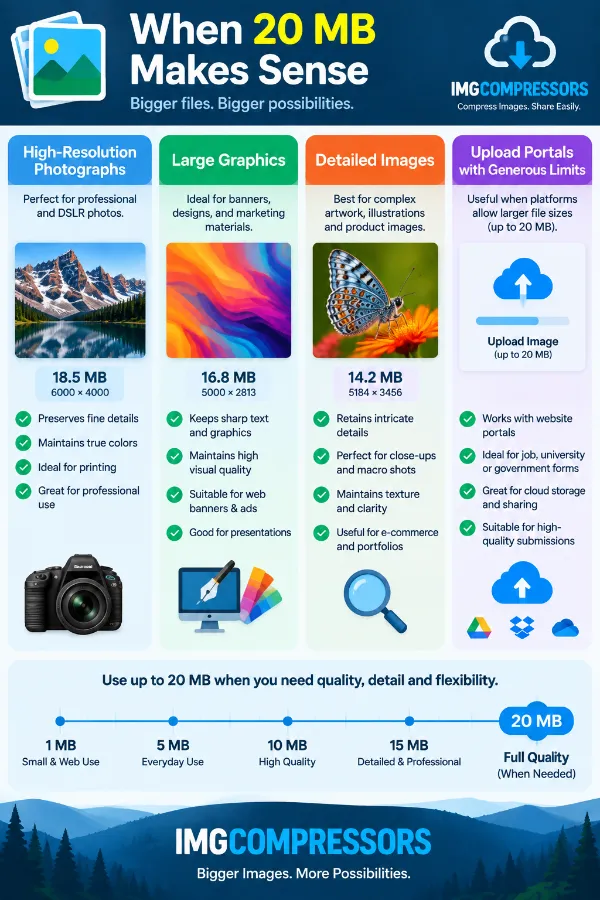
A 20 MB limit can appear on websites, application portals, cloud services, content-management systems, and professional upload platforms. For example, a high-resolution photograph or exported design may be larger than the permitted upload size. Compressing it to 20 MB or below can make it compatible with the stated file-size limit.
My image is 20.3 MB. Do I really need to compress it?
If the destination has a strict 20 MB maximum, then yes. Even a small amount over the limit can cause an upload to be rejected. Reducing the file slightly can bring it within the permitted range without requiring the same level of reduction as a much larger image.
What if the website requires less than 20 MB?
“Less than 20 MB” is stricter than “20 MB or less.” In that situation, a result displayed as exactly 20 MB may not satisfy the requirement. Check the new file size after compression and make sure it is clearly below the limit.
Can I compress a 50 MB image to 20 MB?
Yes, the tool can work toward a 20 MB or below target for an image that starts at 50 MB. However, reducing the file by 30 MB is a substantial amount of compression, so the resulting image may differ more noticeably from the original. The final result should be reviewed before using it for a quality-sensitive purpose.
Is there a difference between reducing a 21 MB image and a 100 MB image to 20 MB?
Yes. A 21 MB image needs only a relatively small reduction, while a 100 MB image requires a much greater reduction. Because of this, the amount of compression and the resulting visual change can be very different even though both images have the same 20 MB target.
Can I compress a high-resolution camera photo to 20 MB without resizing it?
File-size compression and pixel dimensions are separate concepts. A high-resolution photograph can potentially be compressed toward 20 MB without treating the 20 MB target as a specific width or height. If the destination also requires particular dimensions, check those separately after compression.
Why is my image still very large even though its pixel dimensions are not huge?
Pixel dimensions are only one factor affecting file size. Image format, compression characteristics, color information, metadata, and the complexity of the image can also contribute to the final file size. Two images with similar width and height can therefore have very different file sizes.
Why does a PNG sometimes remain larger than expected?
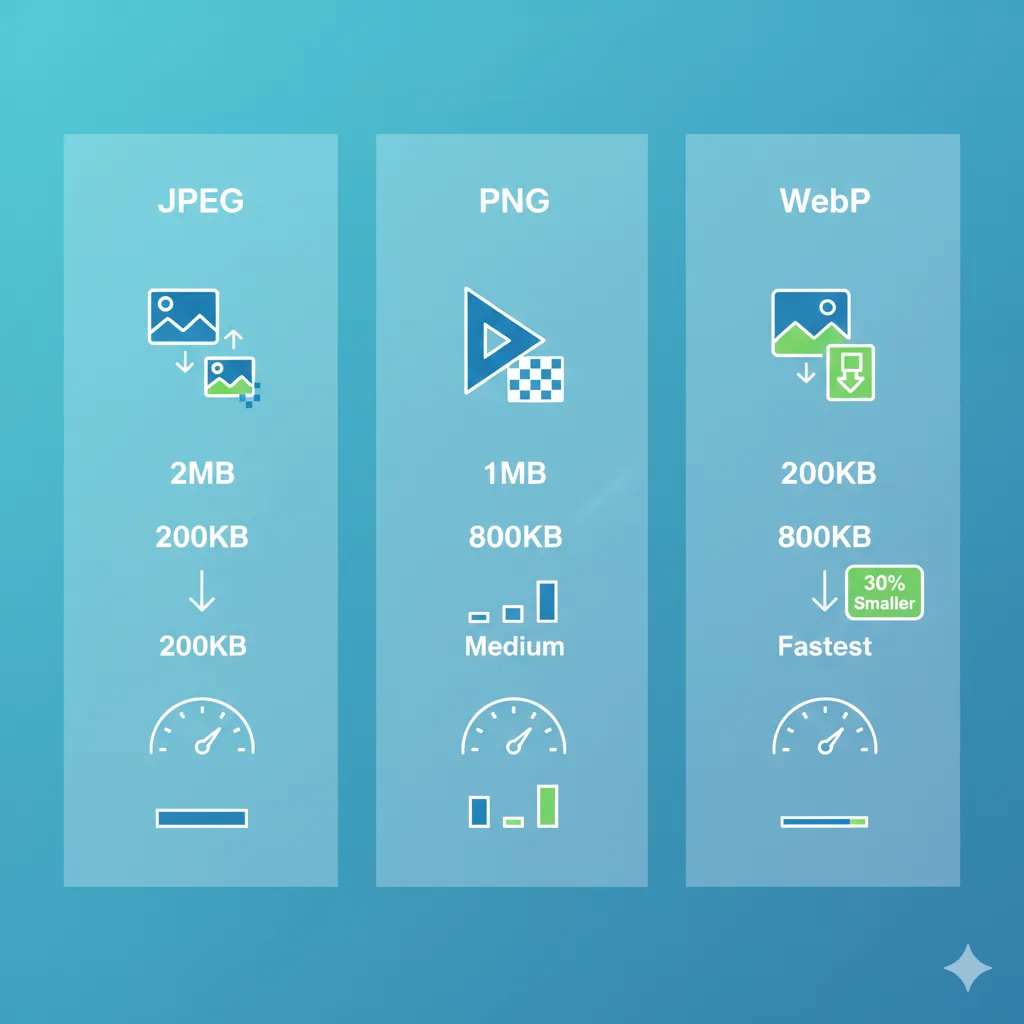
PNG is particularly useful for graphics, transparency, and images with sharp edges, but it can produce relatively large files for certain types of content. A detailed PNG may therefore require more reduction to reach a 20 MB target than expected. The resulting file should be checked for both size and visual suitability.
Does compressing an image to 20 MB remove image metadata?
You should not assume that compression will preserve or remove every piece of metadata in the same way. Metadata can include information such as camera details, timestamps, or other embedded information depending on the source file. If metadata is important to your workflow, verify the processed file separately.
Will a 20 MB image have the same quality as the original?
Not necessarily. If the original is only slightly larger than 20 MB, the visual difference may be small, while a much larger original may require more substantial compression. The final quality depends on the source image, format, content, and amount of reduction required.
Can I use the 20 MB compressor for RAW camera files?
The tool supports the image formats listed on the page rather than every camera-specific RAW format. If your camera produces a RAW file, check whether it is one of the supported formats before uploading it. If it is not supported, you may need to convert it to a supported image format first.
Can I compress a large scanned document to 20 MB?
Yes, if the scan is provided in a supported image format. This can be useful when a document submission portal imposes a 20 MB maximum. However, check small text, signatures, stamps, and other important details after compression to ensure they remain readable.
Can I reduce a professional design or graphic to 20 MB?
Yes, provided the source is in a supported image format. Large exported graphics can sometimes exceed upload limits even when their dimensions are appropriate. After compression, check fine text, sharp edges, transparency, and other elements that are important to the design.
Why should I check the new file size instead of assuming it is below 20 MB?
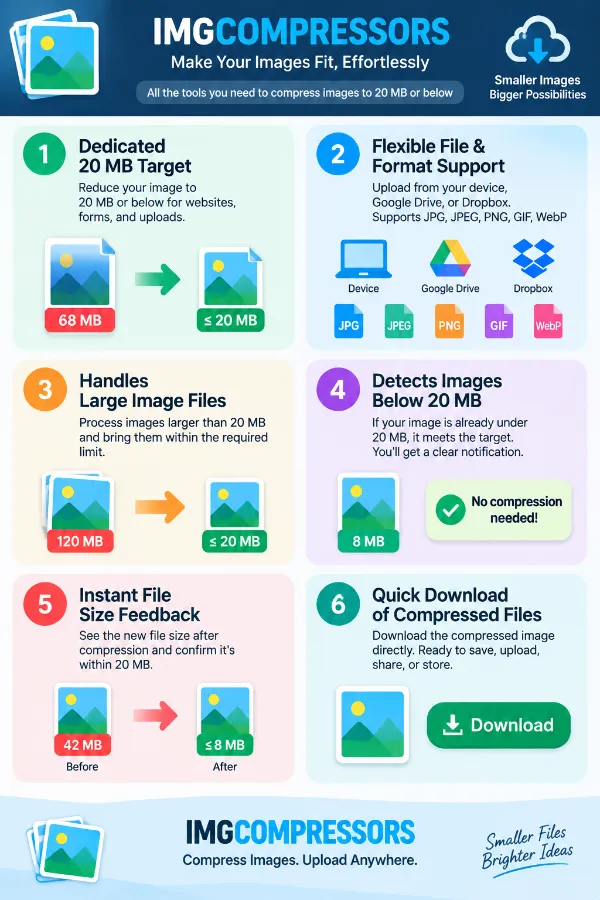
The actual output size is what matters when a website enforces a maximum file limit. The tool displays the new file size after processing, allowing you to verify the result before downloading or submitting it. This is especially useful for files that were only slightly above the limit.
Can compression make an image smaller than necessary?
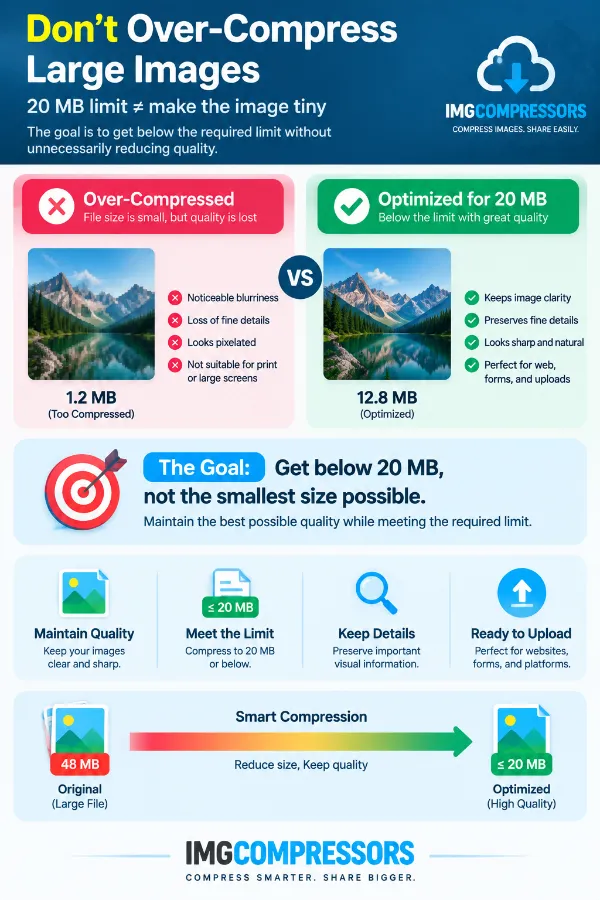
Yes. The target is 20 MB or below, not necessarily exactly 20 MB. A resulting file could therefore be several MB smaller than the target depending on the source and compression process. If your goal is simply to satisfy a maximum-size requirement, being below the limit is generally more important than reaching the exact number.
Can a 20 MB image still be too large for another purpose?
Yes. A 20 MB target only addresses a specific file-size requirement. Another website or application may have a 10 MB, 5 MB, or even smaller limit. Always check the exact requirement of the destination before deciding which target size to use.
Does compressing to 20 MB change the file format?
The supported source formats can be processed within the tool, but you should not assume that reaching the 20 MB target is the same thing as converting the image to another format. File-size compression and format conversion are separate operations.
Can I compress an image that is close to 20 MB without noticeable quality loss?
If the starting file is only slightly above 20 MB, the required reduction may be relatively modest. This can make it easier to reach the target while retaining much of the original appearance. However, the actual result depends on the image, so checking the processed file is still important.
Are my images sent to a server during compression?
No. The tool processes the image directly in your browser rather than sending it to a server. This means your personal, professional, or confidential image does not need to be uploaded to a remote server for the compression process. This browser-based approach can be useful when privacy is important.